Runnable notebooks for
smart contract handoff
Compose reads, writes and raw RPC calls into notebooks that run like Jupyter cells — chained with {{variables}}, simulated before anything is sent, and shared with your team as a single source of truth. Every block generates the exact wagmi/viem code your app can ship — and every instance is an MCP server your coding agent can drive.
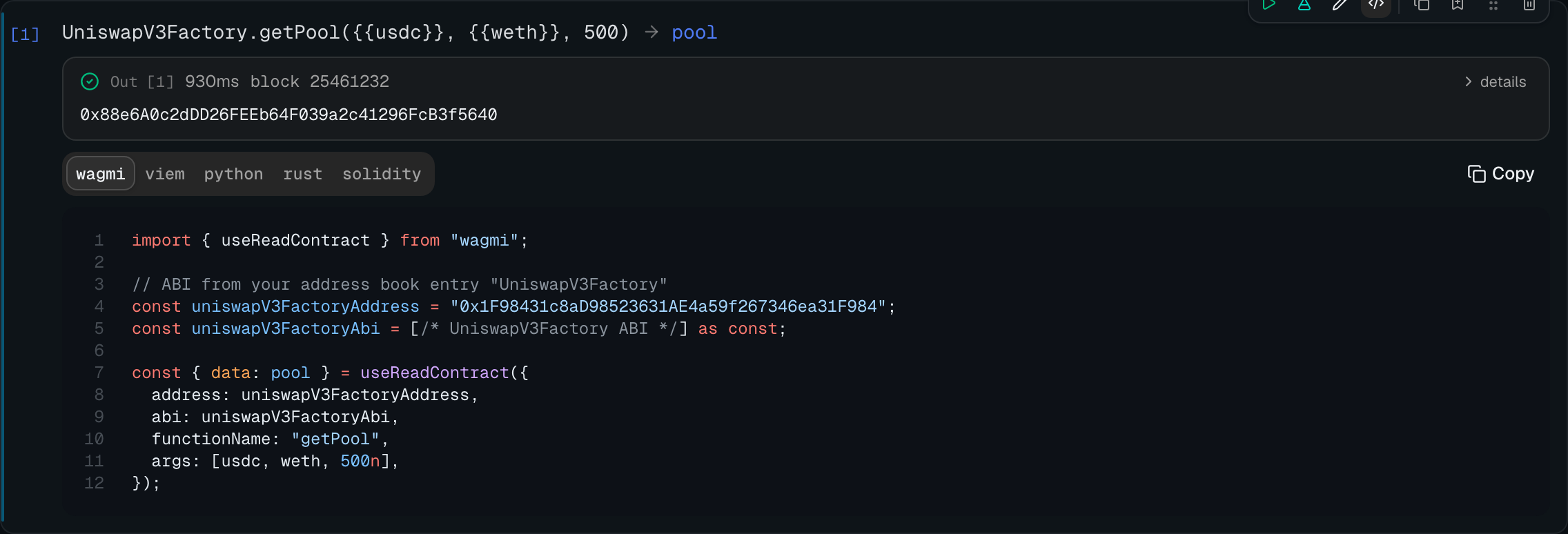
Capscreen from the same seeded example notebook (no wallet needed): deriving the Uniswap V3 USDC/WETH pool from its factory, reading pool state and the Chainlink ETH/USD price — chained with {{usdc}} / {{pool}} against Ethereum mainnet.
Everything that touches a contract, in one document
Chained like Jupyter cells
Run blocks top to bottom; save any output as a {{variable}} and feed it into the next call. Multi-step DeFi flows stay readable — approve → deposit → check balance.
Simulate as anyone
Dry-run entire notebooks as any address on an ephemeral anvil fork — writes impersonate so multi-step state accumulates, then the fork is discarded. Revert reasons and decoded traces surface before anything hits a real chain.
Codegen for the handoff
Every block emits its wagmi, viem, web3.py, alloy or Solidity snippet. The notebook is the integration spec — and it can't drift, because you just ran it.
AI import from Foundry tests
Paste a .t.sol file and it converts into runnable blocks — pranks become sender groups, cheatcodes become RPC cells, asserts become checks. Bring your own free Gemini key.
Recipes & live state
Save any flow as a reusable recipe and rerun it as one cell in any notebook. Pin view functions to a live per-contract dashboard, refreshed in one multicall.
Team-ready sharing
Sign-In with Ethereum, invite by wallet address, viewer/editor/owner roles, per-project guests, and “anyone with the link” URLs — no email server to run.
Two modes, one env var apart
The same codebase and the same database serve a private single-user tool and an invite-only team instance.
Local (default)
- No login, no accounts — clone it and run it
- Everything in one SQLite file on your machine; no telemetry, nothing phones home
npm install && npm run devis the whole setup
Team (APP_MODE=team)
- Sign-In with Ethereum — identity is the wallet, no email server
- Invite-only: wallets get viewer / editor / owner roles, workspace-wide or per project
- Google-Docs-style Share on every project, plus “anyone with the link” URLs
Switching modes keeps all your data — how to self-host.
The notebook is the integration doc
Prove the flow works by running it, then flip the code toggle and copy the exact wagmi hooks or viem calls — ABIs and addresses included from the project's address book. The handoff document stops drifting because it is the same artifact you just executed.
- Per-block or whole-notebook source, in five flavors
- Export any notebook as a JSON call manifest
- Recipes turn multi-step flows into one reusable cell
// .cursor/mcp.json — local mode
{
  "mcpServers": {
    "chainstitch": { "url": "http://localhost:3000/api/mcp" }
  }
}

// team mode — Settings → Agent tokens
{
  "mcpServers": {
    "chainstitch": {
      "url": "https://your-instance/api/mcp",
      "headers": { "Authorization": "Bearer cst_…" }
    }
  }
}

> "Make a notebook that checks the vault's allowance
>  and deposits 100 USDC if it's approved."

⏺ create_notebook … ✓ 6 blocks
  http://localhost:3000/p/…/n/…   ← open, hit Run all
Tools include create_notebook, get_notebook_code, add_contract — verified ABIs fetched by address.
Your coding agent speaks Chainstitch
Every instance is an MCP server — connect Cursor, Claude Code or any MCP-capable agent to /api/mcp and prompts become notebooks: the agent reads the repo it already sits in, assembles the blocks, adds missing ABIs, and hands back a URL to run. Ask for the reverse and any tested notebook comes out as wagmi, viem, Python or Rust source. Local mode needs no credentials; team mode uses a personal API token from Settings.
- No extra process — local needs no key; team mode uses a revocable Bearer token
- Agents write definitions; execution stays in your browser, writes stay signed by your wallet
- Notebooks travel as files too: versioned JSON import/export for PR review
Coming soon
Chainstitch is young and moving fast — this is what's on the bench next.
MCP flow-authoring pack
Templates and stronger agent instructions so deposit/withdraw/… notebooks consistently include expect-event and handoff-friendly variables.
MCP execution tools
Agents can simulate or fork-run a notebook and get receipts back over MCP before sharing with the team.
Deploy blocks
Deploy from a Foundry/Hardhat artifact; the new address becomes a variable and an address-book entry.
Safe Transaction Builder export
Export any flow as a Safe batch — an executable multisig runbook for ops.
Own everything
One SQLite file on your machine. No accounts, no telemetry, nothing phones home. Private keys never touch the server — writes are signed in your browser wallet, reads run straight against your RPC.
npm install && npm run dev # that's it — SQLite bootstraps itself
Step-by-step Docker and team-mode guides live in the docs and the README on GitHub.